From Plans to Proof: Why Delivery Visibility Is Now the Core Capability
TL;DR
Councils are under mounting pressure: costs are up, rates are under scrutiny, capital programmes are harder to deliver, and water investment requirements are rising fast. The issue for many leadership teams is no longer whether they have a plan. It is whether they can see, early enough and clearly enough, what is on track, what is slipping, and where intervention is needed. In that environment, delivery visibility is a core capability, not a nice-to-have.
Local government is not short of planning. Long-term plans are a core part of the system, and the latest round saw 58 councils adopt 2024-34 long-term plans between June and October 2024. (Ref: Summary of Long Term Plans 2025)
What is delivery visibility (and why does it matter)?
Delivery visibility is the ability for council leaders to see, in real time, which projects, services, and risks are on track and which require intervention.
It matters because:
capital programmes are becoming harder to deliver
costs and rates are under pressure
late visibility limits options and increases cost
Without it, issues are often identified too late to respond effectively.
Your ability to execute on strategy may be in question.
For the past few years, a lot of the public discussion has centred on reform, funding, and structure. Those issues have not gone away. But sitting underneath them is a more practical question, and it is the one many chief executives, GMs, and senior managers are dealing with every week: are we actually delivering what we said we would deliver, and would we know soon enough if we were not?
That question matters because the operating environment has become much harder. The Office of the Auditor-General has been unusually direct about the scale of the challenge. In its review of councils’ 2023/24 performance, it noted that councils are facing a growing infrastructure deficit, rising costs, and increasing pressure on financial sustainability. It also reported that councils’ debt has doubled since 2017, and that 47 councils did not meet their balanced budget benchmark in 2023/24.
At the same time, the forward numbers are moving sharply. For the 58 councils covered in the Auditor-General’s 2025 long-term plan analysis, total annual operating expenditure is forecast to rise from $16.2 billion in 2024/25 to $23.2 billion in 2033/34. Rates revenue over the 2024-34 period is forecast at $124.5 billion, which is 45% higher than the same councils forecast in their 2021-31 plans. Councils plan to increase rates steeply in 2026 and 2027, averaging 10.4% in 2026.
None of that automatically means councils are failing. It does mean the margin for late surprises is getting smaller.
And this is where the story shifts from planning to delivery.
The Auditor-General’s work on the 2024-34 long-term plans pointed to material uncertainty in areas that go straight to execution: central government funding assumptions, forecast cost savings, deferred asset renewals, and, crucially, the delivery of capital programmes. Fourteen audit reports specifically drew attention to the risk that councils would not be able to deliver their capital programmes. The reasons were not mysterious: constrained contractor capacity, heavy demand, and uncertainty about external funding.
The backward-looking numbers tell a similar story. In 2023/24, 26 councils spent less than 80% of their capital expenditure budgets. That is not just a finance statistic. It is a delivery signal. It tells us that even where intent, approval, and budget exist, execution is still hard.
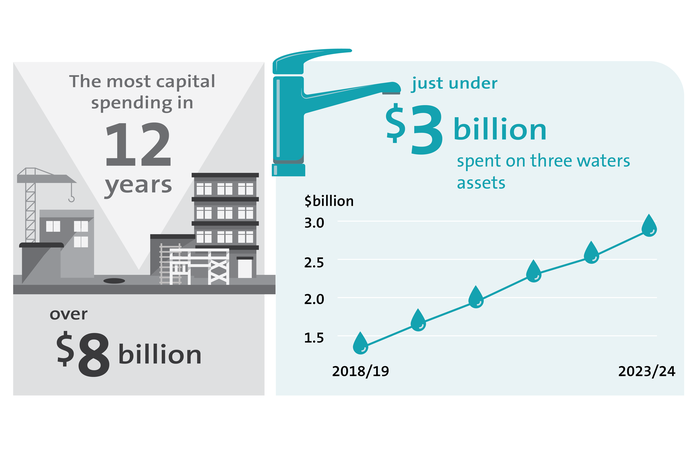
Water adds another layer. Under Local Water Done Well, councils’ water service delivery plans point to an estimated $47.9 billion of water infrastructure investment over the next ten years, around $9 billion more than the estimates in councils’ long-term plans, according to government analysis. Whether one agrees with every aspect of the reform settings or not, the implication is clear enough: the delivery challenge is getting larger, not smaller.
There is also a public affordability dimension here that leaders cannot ignore. Te Waihanga has noted that New Zealanders ultimately pay for infrastructure through user charges, local government rates, and central government taxes, and that households are facing tightening affordability constraints as costs rise and the population ages. You can see that pressure already showing up in annual plan discussions around the country. Tasman District Council, for example, has just consulted on an average 9.9% rates increase for 2026/27, with water costs and recovery from weather events both contributing.
Key facts (NZ local government context):
26 councils spent less than 80% of their capital budgets in 2023/24
47 councils did not meet the balanced budget benchmark
Rates revenue is forecast to increase by 45% over 2024–2034
Water infrastructure investment is estimated at $47.9 billion over 10 years
So what does all this mean for local government leaders?
It means the old comfort of periodic reporting is starting to wear thin. When costs are rising, delivery assumptions are under strain, and public tolerance is low, it is not enough to find out once a quarter that a programme is drifting or that a service issue has been building for months. By then, the real choices are narrower, the fixes are costlier, and the conversation is harder.
That is why delivery visibility matters. Not visibility in the abstract, and not more dashboards for the sake of dashboards. What leaders need is a reliable way to see what is off track, what is changing, and what needs attention now. They need performance, risk, and delivery information to connect in a way that reflects how councils actually operate. They need exceptions to surface early. They need less time spent reconciling spreadsheets and more time making decisions. The principle is simple: when the environment is this demanding, lag becomes expensive.
What performance reporting is should do
The intent behind performance reporting in the public sector is clear. It is meant to provide reliable, timely information about:
what has been delivered
what it cost
and what difference it made
This is not just good practice. It is a core part of public accountability under legislation such as the Local Government Act.
As the Auditor-General puts it, performance reporting should give the public and decision-makers meaningful information they can use to assess performance
That is also the practical case for having a single performance framework rather than a patchwork of disconnected reports. OPAL3 was built around exactly that kind of need: bringing together financial, non-financial, and risk information in one place, supporting real-time dashboards, exception reporting, drill-down visibility, and more consistent reporting across the organisation.
This is the part of the conversation that deserves more attention. Councils will keep planning. They have to. But the harder question now is whether leaders can turn those plans into something visible and manageable in real time.
Because in the current environment, good strategy still matters. But the bigger test is whether the organisation can move from plans to proof.
If this sounds familiar, it’s worth taking a closer look at how your organisation currently tracks delivery. Where are the gaps? How quickly do issues surface? And how much effort goes into producing reports versus actually using them?
If you’re interested, we’re always happy to share how other councils are approaching this in practice, and what’s working. No big pitch, just a useful conversation.